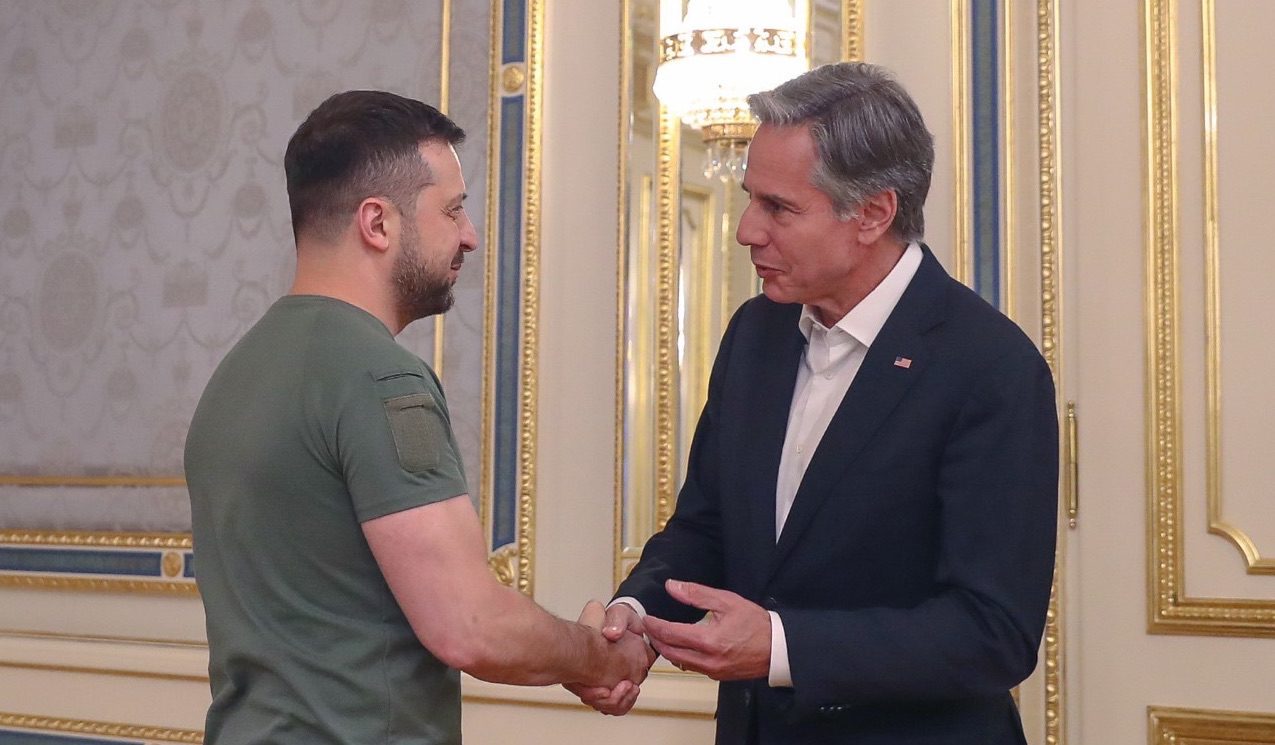
Volodymyr Zelensky and Antony Blinken
Volodymyr Zelensky and Antony Blinken
Speaking to host Russell Brand, leftist Grayzone editor-in-chief Max Blumenthal pointed out that US Secretary of State Tony Blinken stands to “make a lot of money off this war“ through his company WestExec . Ukraine has been “drunk” off of “delusional fantasies out of Washington that they can somehow ‘win’,” Blumenthal said.
“Tony Blinken was recently in Kiev for a more extended period than usual, probably to put the idea of negotiations on the table,” Blumenthal claimed. “This is because of the colossal failure of the Ukrainian counteroffensive, which the US has been heavily involved in.”
The Gateway Pundit is one of the only media in the US reporting about the catastrophic Meat Grinder the US and UK pushed Ukraine into, which has cost approx. 72,000 Ukrainian casualties since June, according to Russian estimates. Blinken visited Kiev Sept. 6, where he met with Foreign Minister Dmytro Kuleba and President Volodymyr Zelensky, promising another $1 billion in US aid. US funds for Ukraine stand at $110.97 billion, Fox News reported on Tuesday.
“They failed to capture any real territory. They were supposed to cut off the land bridge between Russia and Crimea, which is not going to happen,” Blumenthal said. “Soon there’s going to be rain in the eastern plains of the Donbass region, and it’s going to be impossible to get armor through there.”
“It’s a total failure, so why can’t they negotiate?” Blumenthal asked. “Number one, why should Russia negotiate at this point, when the West has stabbed them… and sabotaged negotiations at every turn, leading to this proxy war? Back in April 2022, the US canceled negotiations between Zelensky and the Kremlin and said, ‘Keep fighting’. And they sabotaged the Minsk Accords before that. So why trust the West?”
“And why negotiate when you could actually start capturing more and more territory?” Blumenthal asked, “Given the terrible state of Ukraine’s military and the hundreds of thousands of casualties they’ve suffered? They don’t have much left, apparently.”
Blumenthal also pointed out that US Secretary of State Tony Blinken, “Has major skin in the game when it comes to continuing this war. He founded a firm called WestExec Advisors, which finesses contracts for the arms industry and Big Tech through the Pentagon and the State Department – him and his former colleagues from the Obama Administration founded this firm to profit off their connections with the major winners of the Ukraine proxy war: Raytheon, LockheedMartin, Palantir – all the Beltway Bandits, as we call them here in Washington.”
Past WestExec partners have included DNI Avril Haines, former Biden spokeswoman Jen Psaki and CIA deputy director David Cohen, The Intercept reported 2021.
“If Tony Blinken leaves government, he could make a lot of money off this war, as long as it’s still continuing,” Blumenthal said. “That could be a frozen conflict, where Ukraine is just constantly at war with Russia and its entire society is securitized and mobilized. The tech industry is gonna love that as well because everyone’s gonna be under surveillance, drones and cameras everywhere.”
“Why would they want to end this conflict?” the son of Clinton adviser Sidney Blumenthal asked. “They’re the real winners of this war.”
The Grayzone editor Blumenthal criticized “the hatred of Russia that prevails among the Democratic Party foreign policy elite, but also within the Republican Party, the idea that we can’t ‘lose’ this war, that this is about ‘Democracy’.”
“There’s all these obstacles to negotiations,” Blumenthal said, “but obviously the war isn’t going well. There’s no progress for Ukraine in this war. They should’ve negotiated over a year ago, but they’ve been drunk off of these delusional fantasies spun out of Washington that they can somehow ‘win’, when Victory’s never even defined.”
WestExec represented major corporations throughout the Trump years. Now it’s in the White House.
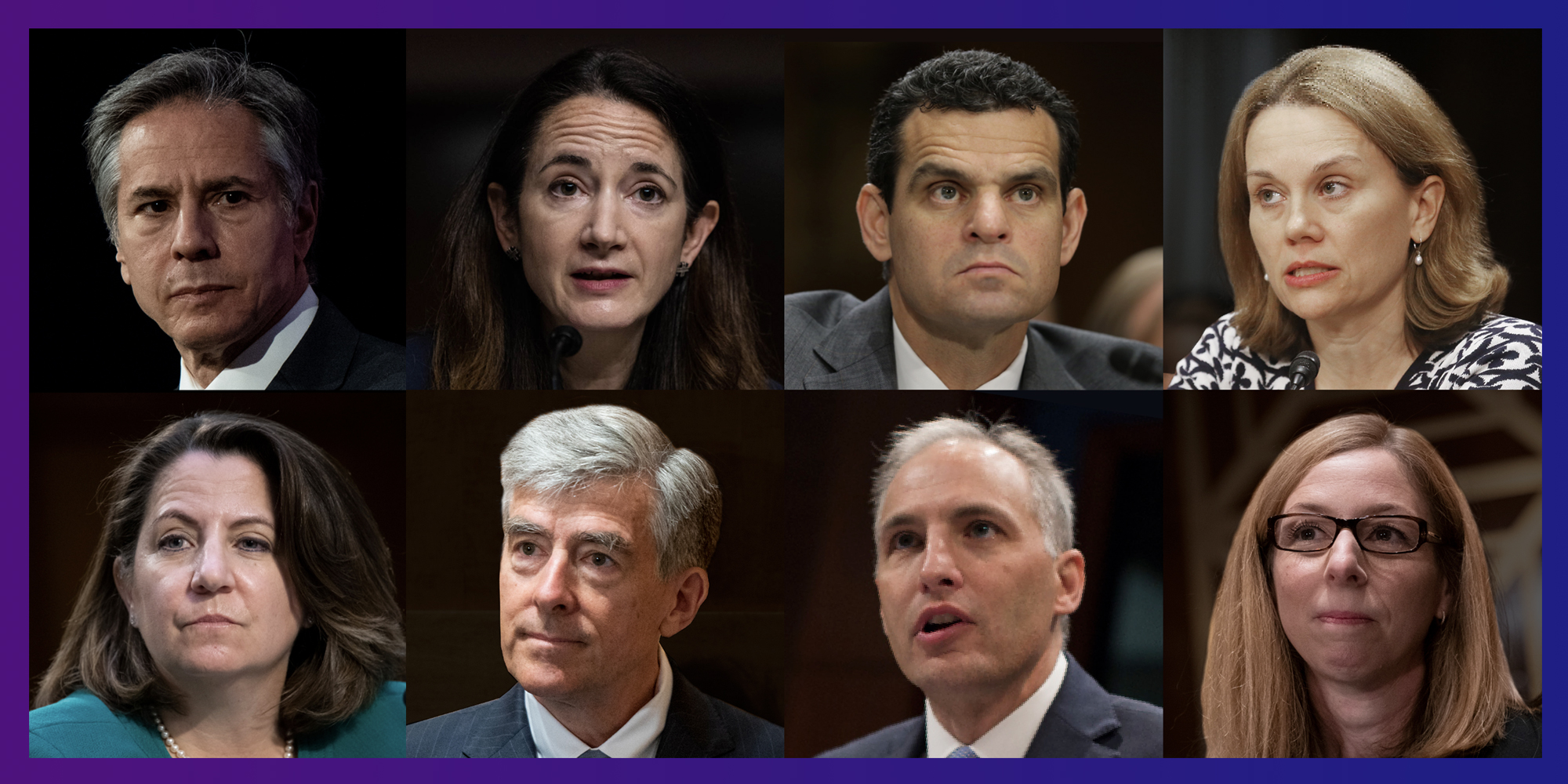
Photo illustration: Soohee Cho/The Intercept, Getty Images, AP
From its headquarters just blocks from the White House, a small, high-powered team of former ambassadors, lawyers, and Obama appointees has spent the past few years solving problems for the world’s biggest companies.
Less than six months into the Biden administration, more than 15 consultants from the firm WestExec Advisors have fanned out across the White House, its foreign policy apparatus, and its law enforcement institutions. Five, some of whom already have jobs with the administration, have been nominated for high-ranking posts, and four others served on the Biden-Harris transition team. Even by Washington standards, it’s a remarkable march through the revolving door, especially for a firm that only launched in 2017. The pipeline has produced a dominance of WestExec alums throughout the administration, installed in senior roles as influential as director of national intelligence and secretary of state. WestExec clients, meanwhile, have controversial interests in tech and defense that intersect with the policies their former consultants are now in a position to set and execute.
The arrival of each new WestExec adviser at the administration has been met with varying degrees of press coverage — headlines for the secretary of state, blurbs in trade publications for the head of cybersecurity — but the creeping monopolization of foreign policymaking by a single boutique consulting firm has gone largely unnoticed. The insularity of this network of policymakers poses concerns about the potential for groupthink, conflicts of interest, and what can only be called, however oxymoronically, legalized corruption.
“The private sector can in essence co-opt the public sector.”
WestExec does not affirmatively share its clients, and public financial disclosure forms only offer broad outlines. Kathleen Clark, a law professor at Washington University in St. Louis, says that government ethics laws written decades ago aren’t equipped to handle a situation in which a single firm launches 15 senior officials. “Yes, they’re employed by the government, I’ll grant you that. But are they actually working for the American people or not? Where does their loyalty lie?” said Clark. “The private sector can in essence co-opt the public sector.”
“These White House officials are experienced government leaders whose prior private sector experience is part of a broad and diverse skill set they bring to government service,” said a White House spokesperson in a statement. WestExec did not reply to a detailed list of questions for this story.
The firm describes one of its chief selling points as its “unparalleled geopolitical risk analysis,” now confirmed by the saturation of its employees in positions of power. WestExec has also succeeded in getting tech startups into defense contracts and helped defense corporations modernize with tech; it worked to help multinational companies break into China. One of its collaborators is the defense-centered investment group Pine Island Capital Partners, which launched a SPAC, or “blank check” company,” last year. Tony Blinken advised Pine Island and was a part owner. (Michèle Flournoy, another WestExec co-founder, had her nomination to be secretary of defense nixed. President Joe Biden instead nominated Lloyd Austin, himself a former Pine Island partner but not a WestExec consultant.)
What makes WestExec “boutique” is the promise that its executives would have face time with its seasoned policymakers. “We felt other firms brought people in for big names and never got to see the big names,” said one WestExec co-founder in 2020. “Tony is on client calls.”

The WestExec to Biden administration pipeline, part one.
Graphic: Soohee Cho/The Intercept
Blinken, now secretary of state, advised household names like telecommunications giant AT&T, defense contractor Boeing, shipping magnate FedEx, and the media company Discovery as a WestExec founding partner. He worked for Big Tech pillars Facebook, LinkedIn, Microsoft, and Uber. He helped niche companies like speakers bureau GLG, art seller Sotheby’s, and biopharmaceutical company Gilead Sciences. Blinken also lists clients that are global investment firms and asset managers, like Blackstone, Lazard, Royal Bank of Canada, and the multinational conglomerate SoftBank — which does extensive business with the Kingdom of Saudi Arabia. He even advised the consulting group McKinsey & Company. Though Blinken left WestExec in July 2020 — after The American Prospect inquired about the relationship — each of these businesses has an international profile that may impact his calculations as he implements Biden’s foreign policy.
Blinken also brought several of his key staff members at the State Department with him from WestExec. His senior adviser Julianne Smith, who listed Boeing and SoftBank as clients, earned $34,000 as a WestExec consultant while holding down a full-time role at the think tank German Marshall Fund. Smith has been nominated to be permanent representative to NATO. (Blinken also brought WestExec executive assistant Sarah McCool to the State Department as his director of scheduling.) Barbara Leaf, a former ambassador to the United Arab Emirates, worked for the firm and advised the National Basketball Association. She went on to serve as Biden’s senior director for the Middle East at the National Security Council. Leaf awaits a vote to be the State Department’s assistant secretary for Near Eastern affairs. Meanwhile, consultant Daniel B. Shapiro, Obama’s ambassador to Israel and a “very busy” early member of the firm, according to his colleague, is being floated as a Middle East envoy. The Prospect revealed last summer that one of WestExec’s clients was Windward, an Israeli artificial intelligence company that specializes in ship tracking.
The firm also provided a comfortable place for Biden’s most powerful intelligence chiefs to wait out the Trump administration. Director of National Intelligence Avril Haines had her name scrubbed from WestExec’s website early on, but she worked with the firm from October 2017 to July 2020, when she joined Biden’s transition team as foreign policy lead. According to a questionnaire completed before her confirmation hearing, she delivered “strategic advice” on “cyber norms; national security threats; and testing, evaluation, validation and verification of machine learning systems by the Department of Defense” to clients like Facebook, JPMorgan Chase, Microsoft, and Open Philanthropy. Deputy Director of the CIA David S. Cohen was an early member of WestExec’s “core team” alongside Haines and Blinken. But it’s impossible to know who his clients were, because an exemption for the spy agencies’ officials means that his disclosure is not publicly available.
“That exempts them from public accountability,” said Clark, the ethics expert at Washington University, “and that’s a problem because we can’t necessarily rely on internal controls and external, public disclosure.” A CIA spokesperson declined to share the companies Cohen worked for at WestExec.
Then there’s Chris Inglis, who the Senate recently approved as national cyber director. He earned $15,000 from the firm and worked for internet security outfit CrowdStrike and email encryption company Virtru.
Since its founding in 2017, WestExec’s focus has been to enhance the capabilities of defense, intelligence, and law enforcement agencies. It partners with the Silicon Valley venture firm Ridgeline, which describes itself as “mission-driven” — meaning that unlike some tech investors, which avoid working with the military, Ridgeline seeks out military products. Both Cohen and Inglis appeared on Ridgeline’s website, and through that partnership, Blinken invested in the venture group’s many portfolio companies. The obscure startups have kooky names (Agolo, Doodle, Wallaroo, etc.) but are innovating advanced technologies like drones, artificial intelligence, and robots. The alumni of WestExec are deeply engaged in emerging tech, which could lead to conflicts of interest as they take on policymaking roles that affect the contracts the government greenlights.
One of the administration’s most visible faces also worked at the firm. Jen Psaki, now the White House press secretary, was a senior adviser to WestExec, where she did crisis communications for the Israeli facial recognition software company AnyVision and advised the nonprofit Spirit of America.

The WestExec to Biden administration pipeline, part two. Not pictured: senior adviser to the domestic policy adviser Erin Pelton; director of scheduling for the secretary of state Sarah McCool; nominee for assistant secretary of defense Celeste Wallander; Biden-Harris transition team advisers Andrea Kendall-Taylor, Cristina Killingsworth, Jay Shambaugh, and Puneet Talwar; deputy director for the U.S. Cyberspace Solarium Commission John Costello; and vice chair of the National Security Commission on Artificial Intelligence Robert O. Work.
As companies faced the Covid-19 pandemic’s massive challenges, Lisa Monaco joined Blinken on client calls. As a WestExec adviser, she worked for Boeing and SoftBank. Now Monaco is the U.S. deputy attorney general. Before Matt Olsen earned millions of dollars as a senior official at Uber, he worked early on as a principal for the firm. Biden has nominated Olsen to be assistant attorney general in the National Security Division.
Ely Ratner is developing China policy for the Defense Department as assistant secretary for Indo-Pacific security affairs. At WestExec, according to his Office of Government Ethics forms, “Billable hours were for background white papers without identified clients and most income was passive retainer.” Though he only earned $11,450 at WestExec, he did so while making more than $400,000 at the think tank Center for a New American Security.
Gabrielle Chefitz, a senior associate of WestExec, joined the Pentagon as special assistant to the under secretary of defense for policy. In June, Biden nominated WestExec senior adviser Celeste Wallander to be assistant secretary of defense for international security affairs.
WestExec’s consultants are so connected and pedigreed that they often hold down multiple jobs, appointments, and titles. That’s how someone like Elizabeth Rosenberg, a former WestExec senior adviser, can join the Treasury Department as a senior official without much notice. At the end of May, Biden nominated Rosenberg to be Treasury’s assistant secretary for terrorism financing. In her LinkedIn profile, she says she has managed federal initiatives to “promote financial transparency.” Her role at WestExec fell off the bio that the White House released publicizing the nomination.
The U.S. Agency for International Development administrator’s office is also full of the firm’s consultants. Colin Thomas-Jensen “advised WestExec and its clients on due diligence and navigating political risk in Sub-Saharan Africa,” and those clients included Boeing, SoftBank, and Delta Capital Management, a venture capital firm that specializes in financing litigation. In April, Thomas-Jensen joined USAID as national security director. That month, WestExec’s Latin America expert Michael Camilleri began serving as senior adviser to Administrator Samantha Power and as executive director of the agency’s Northern Triangle Task Force. As a WestExec consultant, he advised Blackstone, SoftBank, the Intel founder’s multibillion-dollar nonprofit Gordon and Betty Moore Foundation, and the mineral extraction company Rio Tinto.
And it’s not just international policy that will be shaped by the firm. Erin Pelton, who works in the White House as a senior adviser on domestic policy, provided advisory services to WestExec. And the nominee to be the Department of Commerce’s assistant secretary for industry and analysis, Grant Harris, has a connection to the firm. His personal consulting firm Connect Frontier, which advises companies and organizations working in developing markets, hired WestExec.
Even Bidenworld’s backbenchers are entangled in the firm. The Biden-Harris transition team was advised by WestExec consultants Andrea Kendall-Taylor, Puneet Talwar, Jay Shambaugh, and Cristina Killingsworth. Further, the firm’s members oversee influential nonpartisan federal commissions: Robert O. Work at the National Security Commission for Artificial Intelligence and John Costello at the Cyberspace Solarium Commission.
“West Exec’s advisors have worked together at the highest levels of government, navigating and anticipating the impact of international crises on decision making — we can provide the same insights and strategies to business leaders around the world,” Blinken said in an early pamphlet advertising the firm.
A half-year after Blinken’s return to government, the pamphlet is still featured on WestExec co-founder and managing partner Nitin Chadda’s LinkedIn profile. It’s a reminder to potential clients about the firm’s enduring proximity to power.
by Richard Abelson

The first British Challenger 2 tank ever destroyed in combat outside Robotyne
“US State Secretary arrives in Kyiv for two-day visit, brings US$1 billion”, Ukrainska Pravda writes. Russia claims to have destroyed the first British Challenger tank ever on the battlefield.
“During his two-day visit, which will see Blinken stay overnight in Ukraine for the first time since Russia’s invasion in February 2022, he is likely to announce a new US aid package worth over US$1 billion, a senior State Department official said during a press briefing on the trip”, according to Ukrainska Pravda.
Blinken will meet with his Ukrainian counterpart Dmytro Kuleba, and President Volodymyr Zelenskiy, The Guardian reports.
On the weekend, Zelensky fired Defense Minister Oleksii Reznikov over corruption charges, replacing him with Crimean Tartar Rustem Umerov, in a move Jack Posobiec interpreted as designed to justify an attack on primarily Russian-speaking Crimea: “Noticed yesterday an astroturfed ‘Crimean Tatar/Ukrainian activist’ popped up on Twitter, now Zelensky appoints a Crimean Tatar as the new head of the Ukrainian MOD. NATO has found the token ‘oppressed group’ to ‘liberate’ in the upcoming ‘intervention'”, Posobiec wrote.
By sacking Reznikov, “Zelensky is showing paranoia and desperation,” writes Egyptian observer Ahmed Adel, “as reports emerge that Ukraine is preparing for another counteroffensive using students, factory workers and overage men. Ukraine has suffered from corruption scandals in the military, recruitment problems, failures at the front, and doubts about sustained Western military support,” Adel writes.
A video on Twitter seemed to show the first British Challenger 2 tank destroyed in combat. The tank was filmed from a car trying to flee the fighting, presumably on the southern Zaporizhzhia front outside of Robotyne, which has seen the most intense fighting in recent days. The video source claimed the destroyed Challenger 2 tank most likely belonged to the elite Ukrainian 82nd Air Assault Brigade.
“Western sources indicated on Tuesday night that the tank first struck a Russian mine on Monday, which blew a rear fuel compartment, causing it to be immobilised. The crew then evacuated safely, but as it lay dormant it was then hit by a Lancet drone“, The Guardian reports.
UK Defense Secretary Grant Shapps confirmed on Wednesday that a Challenger 2 had been destroyed by Russian forces, saying that London is not going to send a new tank as a replacement. “We gifted 14 of these Challenger 2 tanks to Ukraine. We accept that in the war zone, there can be material losses,” Shapps said.
On Sept. 3, the Ukrainian Ministry of Defense posted a video of a soldier lauding the Challenger 2, saying that “We could use a few more companies in Ukraine… Russian tanks would be too scared to come out.”
According to Forbes, five of Ukraine’s Leopard 2 tanks have been destroyed during the ongoing counteroffensive. Russia has claimed as many as 25 Leopard 2 tanks destroyed, but many may have been damaged and repaired, as Ukraine claims.
Writing on Russia Today, Russian military analyst Ilya Kramnik criticized that “the Ukrainian counteroffensive was launched with a clear lack of artillery, tanks, and particularly engineering equipment, despite the fact that NATO Supreme Allied Commander General Christopher Cavoli declared that Ukrainian troops were fully equipped.“
In the face of $100 billion in Western arms for Ukraine, Kramnik claims that “Soviet-made military equipment, or Eastern European equipment produced under a Soviet license, has turned out to be the most effective for Ukraine’s army. Soviet tanks, infantry fighting vehicles, and other equipment that does not require special training, maintenance, infrastructure, and ammunition can be put into battle immediately, and its combat readiness level is higher compared to Western models that need to be incorporated into the new environment.“
The ball is now “in Russia’s court,“ Kramnik believes. “It depends on Russia how well this opportunity is used. It is quite likely that the initiative to transfer Western fighter jets to Ukraine will be quietly abandoned, since the AFU (Ukrainian Army) will no longer be able to use them. Russia knows full well that this is the case. In theory, this state of affairs should increase the willingness of the US to negotiate, although the upcoming election season will greatly complicate any potential talks. So, unless something extraordinary happens, the West will most likely continue to support the Ukrainian armed forces to the extent necessary to continue resistance. This means Ukraine will not have enough equipment and weapons to launch a large-scale new counteroffensive unless the US decides to share its weapons arsenals.”
US Republican presidential candidate Vivek Ramaswamy believes the Biden Regime’s claims that all aid to Ukraine is being carefully tracked are false:
“Zelensky’s veiled threat to forgo democratic elections in Ukraine unless the American people foot the bill and cough up another $135 million in funding represents a new level of extortion of the United States. Our nation is being duped by a leader in Ukraine willing to sacrifice his own nation’s credibility as a “democracy” in a gambit to secure even more money from U.S. taxpayers. This is wrong,” Ramaswamy wrote on Twitter.
“Vladimir Putin has acted in a craven manner, but that shouldn’t trick the U.S. establishment into adopting the false narrative that Zelensky is a paragon of democratic leadership. He is not. In a span of just two years, Zelensky has made moves that bear a striking resemblance to the tactics employed by Vladimir Putin: Zelensky’s actions include the banning of 11 opposition parties and the consolidation of all state media into a single entity. These actions not only mirror Putin’s refusal to register opposition parties but also extensive government control over the media landscape.
We have more than fulfilled U.S. commitments to Ukraine in the 1994 Budapest Memorandum, even as we have badly violated James Baker’s February 1990 “Not One Inch” commitment to the Soviet Union’s then-President Mikhail Gorbachev about limiting NATO expansion.
We will be Uncle Sucker no more. With over $135 billion in funding already provided, Ukraine should easily be able to allocate 0.1 percent of that to pay for their election. Of course, the mainstream media and the establishment will say that any money the U.S. sends to support Ukraine is strictly “itemized and audited” so that it can’t be used that way. This is a joke funnier than any Zelensky could have written in his prior career as a comedian. Don’t forget that in June, the Pentagon itself discovered an “accounting error” that artificially created an extra $6.2 billion for Ukraine without Congressional approval. The notion that all money and military equipment being sent to Ukraine is being carefully tracked is deeply dishonest. Americans deserve the TRUTH,” Ramaswamy wrote.
Speaking at the Kiev Security Forum with former CIA Director General David Petraeus on Tuesday, Ukraine’s National Security and Defense Council head Aleksey Danilov argued that “World War III has already begun”.
“If somebody thinks that World War III hasn’t started then it’s a huge mistake. It has already begun. It had been underway in a hybrid period for some time and has now entered an active phase,” Danilov said.